
Have you ever felt responsible for your partner’s happiness? Do you find yourself saying yes when you really want to say no, worrying about upsetting your partner, or feeling guilty when you put your own needs first?
These experiences may signal codependency in a relationship.
Codependency occurs when a person’s sense of worth, emotional security, or identity becomes overly dependent on another person’s needs, approval, or behaviour. It often involves people-pleasing, difficulty setting boundaries, fear of rejection, and feeling responsible for a partner’s emotions.
The key distinction is that loving someone and depending on them aren’t unhealthy. Healthy relationships require emotional connection and mutual support. Problems arise when maintaining that connection consistently comes at the expense of your own emotional well-being.
Let’s explore what this can look like in everyday relationships.
Key Takeaways
- Codependency often involves putting your partner’s needs ahead of your own, even when it causes distress.
- Common signs include people-pleasing, fear of abandonment, difficulty setting boundaries, and excessive responsibility for a partner’s feelings.
- Codependent behaviours may develop through early relationship experiences, attachment insecurity, or learned patterns of caregiving.
- Healthy relationships allow both partners to maintain their individuality while supporting each other.
- With awareness, healthier boundaries, and professional support when needed, these relationship patterns can change.
Table of Contents
- What Is Codependency in a Relationship?
- What Codependency Looks Like: Meet Emily and Jake
- Seven Common Signs of Codependency
- Why Do People Develop Codependent Patterns?
- Codependency vs. Healthy Interdependence
- How to Break the Cycle of Codependency
- Can Couples Counselling Help?
- Questions to Ask Yourself
- Frequently Asked Questions
- A Final Thought: Love Without Losing Yourself
What Is Codependency in a Relationship?

Codependency describes a pattern in which one person’s emotional well-being becomes excessively tied to another person’s feelings, needs, approval, or behaviour.
For example, you might feel calm only when your partner is happy, become anxious when they seem distant, or struggle to express disagreement because you fear damaging the relationship.
Over time, you may begin organizing your life around keeping your partner comfortable rather than considering what you need.
Codependency is not a formal mental health diagnosis in the DSM-5-TR. It is a commonly used term to describe patterns of emotional overdependence, self-sacrifice, and boundary difficulties.
According to Cleveland Clinic, codependent relationships can involve significant imbalances in emotional responsibility, caregiving, and personal needs.
The central question is not whether you need your partner. It is whether you feel you must abandon yourself to keep the relationship.
What Codependency Looks Like: Meet Emily and Jake
Disclaimer: Emily and Jake are fictional characters created for illustrative and educational purposes. Their experiences illustrate common relationship patterns associated with codependency. Any resemblance to actual individuals, couples, or personal circumstances is purely coincidental.
Emily and Jake have been together for five years.
They love each other, enjoy spending time together, and describe themselves as best friends. From the outside, their relationship appears close and supportive.
But underneath their connection, both partners have developed patterns that leave them feeling increasingly anxious, misunderstood, and emotionally exhausted.
A Typical Morning: When Your Partner’s Mood Determines Your Day
Jake wakes up and notices Emily is unusually quiet.
“Are you okay?” he asks.
“I’m fine. I’m just tired,” Emily responds.
A few minutes later, Jake asks again.
“Are you sure? You seem upset.”
Emily sighs. “Jake, I’m really okay. I just need some quiet this morning.”
Jake immediately feels anxious.
Did I do something wrong? Is she upset with me? Why doesn’t she want to talk?
For the next hour, Jake struggles to concentrate because he is preoccupied with Emily’s mood.
What’s happening here?
Jake struggles to separate Emily’s emotional experience from his own sense of security.
Instead of recognizing that Emily can be tired, distracted, or upset without it necessarily being about him, Jake feels compelled to make things better.
His caring intentions have become mixed with anxiety and a need for reassurance.
An Evening Decision: When Saying No Feels Dangerous
Later that week, Jake suggests visiting friends.
Emily is exhausted and would prefer to stay home.
“I don’t really feel like going tonight,” she says.
Jake looks disappointed.
“Oh. I thought we’d have fun together.”
Emily immediately feels guilty.
“Okay, we can go. It’s fine.”
But it isn’t fine.
Emily spends the evening feeling resentful because she agreed to something she didn’t want to do.
What’s happening here?
Emily is prioritizing Jake’s possible disappointment over her own needs.
Rather than tolerating the discomfort of saying no, she sacrifices her preference to preserve harmony.
Over time, repeated moments like this can create resentment and emotional distance.
A Difficult Conversation: When Helping Becomes Controlling
One evening, Emily comes home upset after a difficult day.
Jake immediately offers suggestions.
“You should talk to your boss. Maybe you need to change jobs. Have you thought about what I said last week?”
Emily responds, “Jake, I don’t need you to fix this. I just want you to listen.”
Jake feels rejected.
“I’m only trying to help.”
Emily withdraws, and Jake becomes more anxious.
They both end up feeling alone.
What’s happening here?
Jake genuinely wants to help, but his discomfort with Emily’s distress makes it hard for him to simply be present.
Emily experiences his attempts to help as pressure, while Jake experiences her request for space as rejection.
Neither partner intends to hurt the other, yet their responses reinforce the same painful cycle.
Seven Common Signs of Codependency
Codependency does not look identical in every relationship. Some people become overly accommodating, while others respond to insecurity by becoming controlling or excessively involved.
Here are seven patterns worth recognizing.
1. You Feel Responsible for Your Partner’s Happiness
You may believe it is your job to prevent your partner from feeling sad, disappointed, frustrated, or anxious.
For example:
- You apologize even when you haven’t done anything wrong.
- You feel uneasy when your partner is upset.
- You constantly monitor their mood.
- You believe a good partner should always know how to make things better.
A healthier perspective: You can care deeply about your partner’s feelings without being responsible for managing every emotion they experience.
2. You Struggle to Say No
You agree to plans, responsibilities, or expectations because you fear disappointing your partner.
You might say:
“It’s okay. Whatever you want.”
But internally, you feel exhausted or resentful.
Healthy boundaries are not a rejection of love. They allow both partners to express their needs honestly.
3. You Need Constant Reassurance
You may frequently wonder:
- Are they upset with me?
- Do they still love me?
- Why haven’t they texted?
- What if they leave?
- Did I say something wrong?
Reassurance can be helpful in any relationship. However, when reassurance provides only temporary relief, you may become caught in a cycle of anxiety and repeated checking.
4. You Avoid Conflict to Keep the Peace
You may believe that disagreement threatens the relationship.
As a result, you suppress your feelings, avoid difficult conversations, or agree with things you don’t believe.
Unfortunately, avoiding conflict does not necessarily create emotional safety.
It may simply prevent important issues from being addressed.
5. You Lose Touch with Your Own Identity
You may gradually stop pursuing friendships, interests, or activities that matter to you.
Your decisions become centred on your partner’s preferences.
Eventually, you might ask yourself:
“Who am I outside this relationship?”
A healthy connection should make room for two individuals, not require one to disappear.
6. You Try to Rescue or Fix Your Partner
You may feel compelled to solve your partner’s problems, protect them from consequences, or take responsibility for changing their behaviour.
This can create an exhausting cycle.
The more you take responsibility, the less opportunity your partner may have to develop their own solutions.
Supporting someone and rescuing someone are not always the same thing.
7. You Feel Guilty for Taking Care of Yourself
Spending time with friends, resting, pursuing hobbies, or setting limits may leave you feeling selfish.
You may worry that taking care of yourself means you are neglecting your relationship.
Yet healthy relationships require both partners to have emotional space, autonomy, and opportunities for personal growth.
Why Do People Develop Codependent Patterns?
One of the most important things to understand about codependency is that these behaviours often develop for understandable reasons.
Many people learned early in life that maintaining connection meant accommodating others, avoiding conflict, or closely monitoring someone else’s emotional state.
Early Family Experiences
Imagine growing up in a household where a parent’s moods were unpredictable.
You may have learned to watch for subtle changes in their voice, facial expressions, or behaviour.
Perhaps keeping everyone happy helped you feel safer.
As an adult, that same pattern may appear in your romantic relationship.
You become highly sensitive to your partner’s emotions because your nervous system has learned that monitoring others is important.
Attachment Insecurity and Fear of Abandonment
People with anxious attachment patterns may experience heightened sensitivity to perceived rejection or emotional distance.
They may seek reassurance, fear separation, or interpret a partner’s need for space as evidence that something is wrong.
These experiences do not automatically mean someone is codependent, but attachment insecurity can contribute to similar relationship behaviours.
Trauma and Learned Survival Strategies
For some individuals, people-pleasing, conflict avoidance, or excessive caregiving developed as ways to cope with difficult experiences.
These behaviours may once have helped reduce conflict or maintain connection.
However, strategies that were protective in one environment may become limiting in another.
Importantly, codependency does not always result from trauma, and not everyone who has experienced trauma develops codependent patterns.
Mental Health America describes codependency as a learned pattern that can develop within family and relationship environments.
Understanding where these patterns originated can help people approach change with greater compassion and awareness.
Codependency vs. Healthy Interdependence
A key difference exists between being emotionally connected and becoming emotionally dependent at the expense of your well-being.
Healthy relationships involve interdependence: two people who can rely on one another while maintaining their own identities, responsibilities, and boundaries.
| Codependent Patterns | Healthy Interdependence |
|---|---|
| “I need you to be happy so I can feel okay.” | “I care that you’re upset, and I can support you.” |
| “I can’t say no because you’ll be disappointed.” | “I can say no respectfully, and we can discuss it.” |
| “Your problems are mine to solve.” | “I can help without taking over.” |
| “Disagreement means our relationship is in danger.” | “We can disagree and remain connected.” |
| “I need your approval to feel worthy.” | “Your opinion matters, but I also trust myself.” |
| “We should do everything together.” | “We can enjoy closeness and individual interests.” |
The goal is not complete independence. It is learning how to stay emotionally connected without losing yourself.
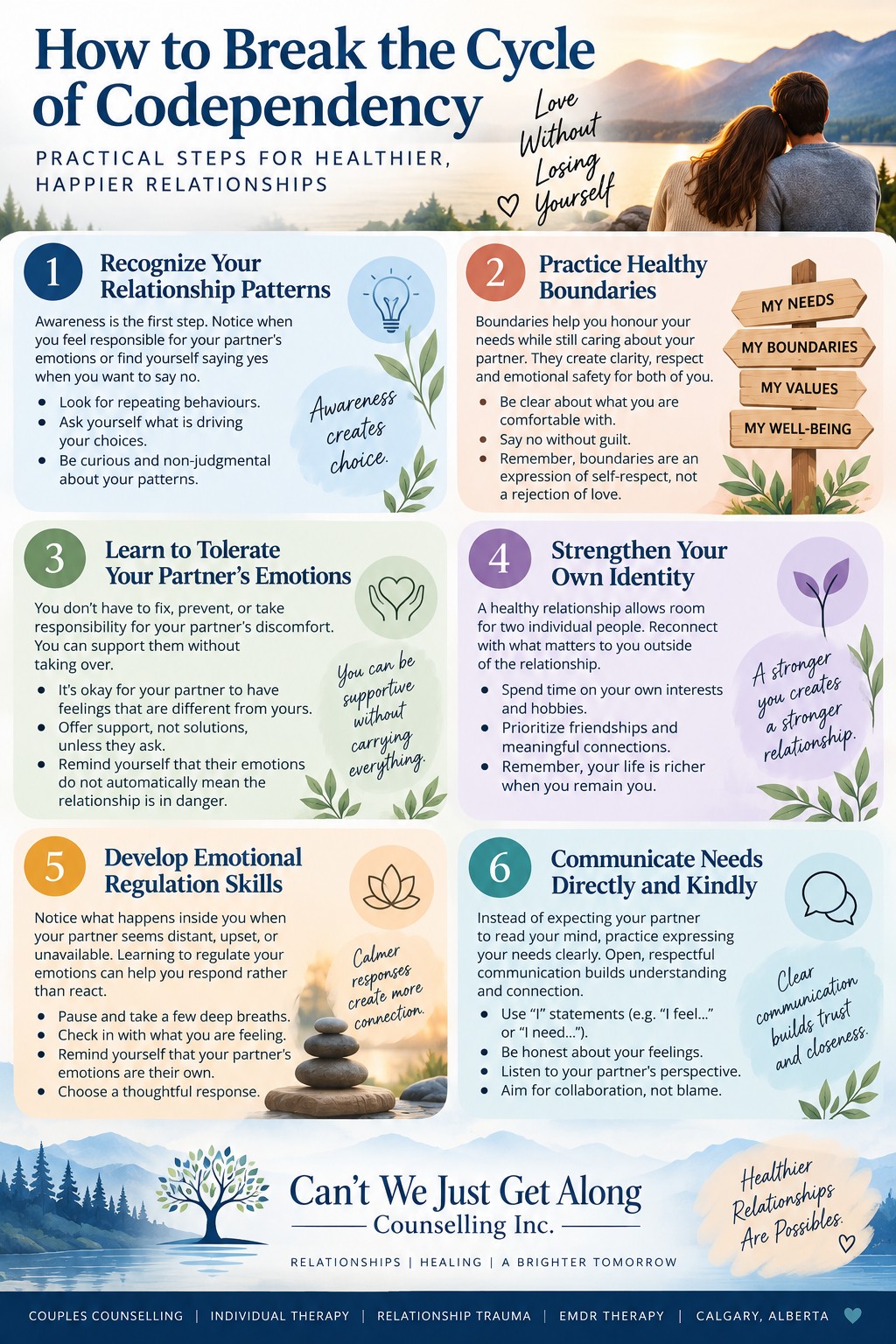
How to Break the Cycle of Codependency
Changing codependent relationship patterns takes awareness, practice, and patience.
Small changes in everyday interactions can gradually create a healthier balance.
1. Recognize Your Relationship Patterns
Start by noticing moments when you feel responsible for your partner’s emotions or abandon your own preferences.
Ask yourself:
“Am I doing this because I genuinely want to, or because I am afraid of what will happen if I don’t?”
That distinction can be revealing.
2. Practice Healthy Boundaries
Boundaries help define what you are comfortable with, what you need, and what you are responsible for.
For example, instead of saying:
“Fine, I’ll cancel my plans if you need me.”
You might say:
“I care about you, and I also need to honour the plans I’ve already made. Can we find another time to connect?”
A boundary can be both kind and firm.
3. Learn to Tolerate Your Partner’s Emotions
You do not have to immediately eliminate your partner’s discomfort.
Sometimes the most supportive response is:
“I can see you’re upset. Would you like me to listen, help you think through it, or give you some space?”
This communicates care without assuming responsibility for fixing everything.
4. Strengthen Your Own Identity
Reconnect with the activities, friendships, interests, and values that matter to you.
Healthy relationships benefit when both partners continue developing as individuals.
You can love someone deeply and still have a life that includes your own goals and interests.
5. Develop Emotional Regulation Skills
When your partner seems distant or upset, notice what happens inside you.
Does your heart race? Do you feel compelled to ask repeated questions? Do you imagine the worst?
Before reacting, try pausing and reminding yourself:
“My partner can have feelings that are different from mine. Their emotions do not automatically mean our relationship is unsafe.”
Emotional regulation helps you respond thoughtfully instead of reacting out of fear.
6. Learn to Communicate Needs Directly
Instead of expecting your partner to anticipate your feelings, practice expressing them clearly.
For example:
“I notice I become anxious when we haven’t connected all day. Could we talk about a way to stay connected that works for both of us?”
Here is an easy way to hold yourself accountable
Are You Responsible FOR Your Partner or Responsible TO Your Partner?
One of the most important distinctions in overcoming codependency is learning the difference between being responsible for someone and being responsible to someone.
These two approaches may sound similar, but they can create very different relationship experiences.
Being responsible for your partner means feeling obligated to manage their emotions, solve their problems, prevent their discomfort, or control their decisions.
Being responsible to your partner means showing up with honesty, empathy, respect, and accountability while allowing them to take responsibility for their own feelings, choices, and behaviour.
Healthy love is not about carrying another person’s emotional life. It means caring for them while letting both people remain responsible for themselves.
What Does Being Responsible FOR Someone Look Like?
When you feel responsible for your partner, you may:
- Fix: Immediately look for solutions whenever your partner is upset.
- Rescue: Step in to prevent them from experiencing disappointment or consequences.
- Protect: Try to shield them from every uncomfortable feeling.
- Control: Attempt to influence their decisions so you can feel less anxious.
- Carry their emotions: Feel personally responsible for their happiness, anger, sadness, or frustration.
- Stop listening: Become so focused on solving the problem that you miss what your partner is actually saying.
Although these behaviours often come from a place of love, they can leave you feeling anxious, exhausted, resentful, or overly responsible.
You may become more focused on finding the right answer than understanding the person in front of you.
What Does Being Responsible TO Someone Look Like?
Being responsible to your partner means approaching the relationship differently.
You can:
- Show empathy: Acknowledge their feelings without taking them on as your own.
- Encourage: Support their ability to make decisions and solve problems.
- Share: Express your own feelings, experiences, and needs honestly.
- Confront respectfully: Address harmful behaviour or concerns without trying to control the outcome.
- Relate as equals: Recognize that both partners have needs, feelings, and responsibilities.
- Listen: Make room for your partner’s experience without immediately offering solutions.
When you practice being responsible to someone, you may feel more emotionally free, confident, and connected.
You can support someone without becoming consumed by their struggles.
What This Looks Like in a Real Relationship
Imagine your partner comes home feeling frustrated after a difficult day at work.
Being responsible FOR your partner:
“Tell me what happened. I’ll help you figure it out. You need to speak to your boss tomorrow. I hate seeing you upset, and I can’t relax until we fix this.”
Being responsible TO your partner:
“That sounds like a really difficult day. I’m sorry you’re going through this. Would you like me to listen, or would it help to talk through some options?”
In the first example, your partner’s distress becomes something you feel compelled to resolve.
In the second, you offer emotional support while respecting your partner’s ability to manage their own experience.
The difference is not how much you care.
The difference is whether caring requires you to take over.
A Personal Accountability Exercise
The next time you notice yourself becoming anxious about your partner’s feelings or behaviour, pause and ask yourself:
- Am I listening or trying to fix? Does my partner need a solution, or do they simply need to feel understood?
- Am I supporting or rescuing? Am I helping them develop confidence, or am I taking over something they can manage themselves?
- Am I respecting their autonomy or trying to control the outcome? Can I allow my partner to make decisions I might not agree with?
- Am I taking responsibility for something that belongs to them? Is this my emotion, behaviour, or problem to manage?
- Am I being honest about my own needs? Am I sacrificing myself to avoid disappointment or conflict?
- Can I offer love without carrying the outcome? Can I remain caring and connected even when I cannot make everything better?
These questions are not intended to create guilt or self-criticism.
They are opportunities to notice your patterns and make more intentional choices.
An Important Reminder About Accountability
Being responsible to your partner does not mean withdrawing, becoming indifferent, or refusing to help.
You are still responsible for how you speak and behave, the promises you make, the boundaries you establish, and how you respond when you have caused harm.
For example, if you have betrayed your partner’s trust, you are responsible for acknowledging the injury, being honest, and taking meaningful steps toward repair. You cannot simply dismiss their pain by saying their feelings are their responsibility.
Healthy accountability means owning your actions without owning another person’s entire emotional experience.
A Thought to Take with You
You can love someone without rescuing them.
You can support someone without controlling them.
You can listen without fixing.
You can be compassionate without abandoning your own needs.
And perhaps most importantly:
You can be responsible TO someone without being responsible FOR everything they feel.
That is one foundation of healthy interdependence. This encourages collaboration rather than blame.
Can Couples Counselling Help with Codependency?
Yes. Couples counselling can help partners recognize and change relationship patterns involving people-pleasing, emotional overdependence, difficulty setting boundaries, and fear of conflict.
Therapy can provide a space to explore what happens beneath these behaviours.
For example, Jake may discover that Emily’s emotional distance activates fears of rejection.
Emily may recognize that she has learned to avoid disagreement because expressing her needs feels uncomfortable.
Neither partner needs to be labelled as the problem.
Instead, therapy can help both understand the cycle they have developed together.
How Gottman Method Couples Therapy May Help
Gottman Method Couples Therapy focuses on strengthening friendship, emotional connection, communication, and constructive conflict management.
For couples experiencing codependent patterns, relevant skills may include:
- Expressing needs and concerns without criticism.
- Listening without immediately becoming defensive.
- Understanding emotional triggers.
- Developing healthier conflict conversations.
- Respecting differences while maintaining connection.
How EMDR Therapy May Help
For some individuals, codependent behaviours are connected to distressing earlier experiences, attachment injuries, or trauma.
When clinically appropriate, EMDR (Eye Movement Desensitization and Reprocessing) therapy may help address traumatic memories and negative beliefs that contribute to current relationship distress.
For example, someone may carry beliefs such as:
- “I am responsible for everyone else’s happiness.”
- “If I say no, people will leave me.”
- “My needs don’t matter.”
- “I am only valuable when someone needs me.”
EMDR is an evidence-based treatment for PTSD. Its application to codependency itself is less directly established, so treatment should be tailored to the person’s history and needs.
At Can’t We Just Get Along Counselling in Calgary, therapy may involve exploring both today’s relationship patterns and the experiences that shaped them.
An important note: When a relationship involves intimidation, coercive control, or abuse, the priority is safety. These situations should not simply be labelled codependency, and conjoint couples therapy may not be appropriate.
Questions to Ask Yourself
If you recognize some of these patterns, consider reflecting on the following questions:
- Do I feel responsible for keeping my partner happy?
- Can I express disagreement without feeling afraid?
- Do I frequently ignore my own needs to avoid conflict?
- Do I feel anxious when my partner wants time alone?
- Have I given up important friendships or interests?
- Do I feel guilty when I establish boundaries?
- Can I support my partner without taking responsibility for solving their problems?
- Do I feel valued for who I am, or primarily for what I do for others?
These questions are not a diagnostic test.
They invite you to reflect on how you experience closeness, emotional safety, and individuality in your relationship.
Frequently Asked Questions
1. What are the most common signs of codependency in a relationship?
Common signs include people-pleasing, difficulty setting boundaries, fear of abandonment, excessive responsibility for a partner’s emotions, and neglecting your own needs. These patterns become concerning when they repeatedly affect your emotional well-being or relationship satisfaction.
2. Can two people be codependent on each other?
Yes. Both partners can contribute to an emotionally dependent relationship pattern. For example, one partner may constantly seek reassurance while the other feels responsible for providing it, reinforcing a cycle that becomes difficult for either person to change.
3. Is codependency the same as anxious attachment?
No. Anxious attachment describes patterns of insecurity and fear of rejection in close relationships. Codependency is a broader term often used to describe excessive caretaking, self-sacrifice, and reliance on another person’s approval or emotional state. The patterns can overlap.
4. Can a codependent relationship become healthy?
Yes, many couples can improve these patterns through greater self-awareness, healthier boundaries, emotional regulation, and improved communication. Meaningful change requires willingness to recognize and address unhealthy behaviours.
5. Is codependency a mental health disorder?
No. Codependency is not an official diagnosis in the DSM-5-TR. It is a descriptive term for relationship behaviours that may involve emotional overdependence, people-pleasing, or difficulty maintaining personal boundaries.
6. Can EMDR or couples counselling help with codependency?
Couples counselling may help partners understand their interactions, strengthen communication, and develop healthier boundaries. EMDR may also be appropriate when trauma or distressing earlier experiences contribute to relationship difficulties, although it is not specifically established as a treatment for codependency.
A Final Thought: Love Without Losing Yourself
I often remind couples that healthy relationships are not about two people becoming one person.
They are about two individuals learning how to stay connected while respecting their differences, needs, and emotional experiences.
You can love someone without fixing everything for them.
You can care about your partner’s happiness without making it your sole responsibility.
You can set boundaries without withdrawing your love.
And you can remain deeply connected while still being yourself.
Perhaps one of the most important lessons in a healthy relationship is this: I can love you, care about you, and support you without abandoning myself.
Lessons from Melody’s Therapy Room
After more than 25 years of working with individuals and couples, I’ve noticed one theme I encounter often: how easily love and responsibility can become intertwined.
People often believe that loving someone means preventing their pain, avoiding disappointment, or sacrificing their own needs.
But relationships become healthier when partners learn that they can care deeply about each other without carrying every emotion or solving every problem.
Sometimes the work isn’t about learning to love your partner more.
It is about learning how to love your partner without losing yourself in the process.
Codependency and Relationship Counselling in Calgary
If you recognize these patterns in your relationship, individual or couples counselling may help you better understand what is happening and develop healthier ways of relating.
At Can’t We Just Get Along Counselling Inc., we help individuals and couples in Calgary explore relationship difficulties, attachment injuries, emotional regulation, communication, and boundaries.
You don’t have to wait until your relationship is in crisis to start making meaningful changes.
Healthy relationships make room for both connection and individuality.
About the Author
Melody Evans, Registered Psychologist, RMFT
Melody Evans is a Registered Psychologist and Registered Marriage and Family Therapist with more than 25 years of clinical experience. She founded Can’t We Just Get Along Counselling Inc. in Calgary, Alberta.
Her clinical work integrates Gottman Method Couples Therapy, EMDR therapy, attachment-informed approaches, and trauma-informed care to help individuals and couples navigate relationship distress, attachment injuries, and emotional disconnection.