

Healthy, lasting relationships don’t happen by accident—they’re built through intentional connection, shared understanding, and everyday acts of care. Whether you’re dating, engaged, or married, our free Couples Connection Tools can help you strengthen your bond, communicate more openly, and deepen your emotional intimacy. From downloadable Couples Feeling Journals and Love Coupons to pre-marriage assessments, communication games, and household chore planners, each resource is grounded in the proven principles of the Gottman Method. You’ll discover practical exercises to map your partner’s inner world, create rituals of connection, manage conflict more calmly, and dream together about your shared future. Start exploring today and give your relationship the tools it needs to thrive.
Couples Feeling Journals
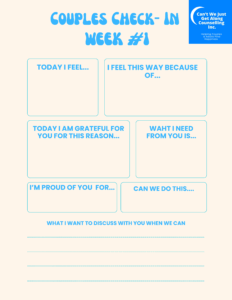
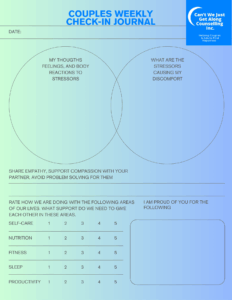
Select the couple’s journey that resonates with you and download it for weekly check-ins and to connect with your partner. The Couples Journal will help you stay connected with your partner, understand their day-to-day challenges and hopes, and enable you to support them through a process of emotional coaching and love mapping. This journal will help you to quickly identify how you’re feeling and share with your partner. We suggest doing it before bed or leaving it at the counter so you can check in with each other from time to time throughout the week. Then, if you identify challenges, bring them to your therapist. They can help you work through whatever challenges you’re facing. This couple’s feeling journal is based on the concept of Love Mapping. What is Love Mapping? Gottman Love Mapping. Gottman Love Mapping, developed by Dr. John Gottman, is a foundational technique in the Gottman Method that helps couples strengthen their relationships and foster emotional intimacy. Here are some of its major components that you will benefit from in doing the Couples Feeling Journal.
Understanding My Partner’s Love Maps
At the heart of Love Mapping is the idea that partners should have a deep understanding of each other’s inner worlds. This includes knowing each other’s likes, dislikes, hopes, dreams, fears, and significant life events. The more detailed and accurate these “maps” are, the stronger the foundation for the relationship.
Importance of Love Mapping
- Emotional Connection: Love Mapping involves partners sharing personal details and experiences, which can foster greater understanding and intimacy.
- Conflict Resolution: Understanding each other’s perspectives and backgrounds may help partners approach conflicts and disagreements with empathy.
- Growth and Change: As individuals evolve, updating Love Maps can help partners stay informed about each other’s growth and development.
- Preventing Drift: Regularly updating Love Maps can support ongoing communication and engagement between partners, ensuring couples feel connected and engaged. All too often, people love maps more with their co-workers than they do with their partner, and that can lead to boundary crossing, affairs and trouble.
Building and Updating Love Maps
Steps to Create a Love Map:
- Ask open-ended questions about each other’s thoughts and feelings, such as memories or current concerns. Open-ended questions are What, When, Where, How, but never Why. Why make people feel backed into a corner and defensive?
- Listen attentively and without judgment.
- Share your insights for mutual understanding.
- Regularly update your Love Maps through ongoing conversations.
Questions to Enhance Love Maps:
- What are your partner’s main goals for the future?
- What dreams have they not achieved yet?
- What worries them most right now?
- What are their favorite hobbies?
- Who are their closest friends, and what are those relationships like?
Using a couple’s feeling journal for Love Mapping helps partners understand each other’s inner worlds, increasing intimacy and empathy. This approach can strengthen bonds, deepen mutual knowledge, and foster a more resilient relationship.
Love Coupons
Some of the most fascinating research from the Gottman Love Lab on the University of Washington campus in the United States has shown that couples who physically turn toward each other tend to stay together. Making a bid to connect with your partner by turning towards them can be achieved using these Love Coupons. Melody has created these love coupons to encourage you and your partner to turn towards each other and make bids of connection to each other. Please take a minute to cut them out, then turn towards your partner and make a bid for affection and connection. We all want to know we are loved, and this is a fun and easy way to let your partner know you care.
Gottman’s Concept of Bidding and the Ritual of Connection
Dr. John Gottman, a renowned relationship researcher, introduced the concepts of “bidding” and the “ritual of connection” as vital components of successful relationships. These concepts are central to his work on understanding how couples interact and build strong, lasting bonds.
What is Bidding?
Bidding involves the small, daily efforts people make to connect emotionally. These bids can be verbal or non-verbal, usually expressed through simple gestures, comments, or actions aimed at gaining attention, affirmation, or affection. Examples include a smile, asking about someone’s day, or a gentle touch on the shoulder.
What Are the Types of Bids?
Verbal Bids: These involve direct communication such as asking questions, sharing thoughts, or making comments, as well as requesting things from your partner.
- Non-Verbal Bids: These include gestures or actions like eye contact, a hug, or a pat on the back.
- Responses to Bids
- According to Gottman, there are three main ways people can respond to bids:
- Turning Toward: Responding positively or neutrally to the bid, which strengthens the relationship.
- Turning Away: Ignoring or missing the bid, which can potentially create distance between partners.
- Turning Against: Responding negatively to the bid, which can potentially lead to conflict and weaken the relationship.
Gottman’s concepts of bidding and the ritual of connection emphasize the importance of everyday interactions and shared traditions in building and maintaining strong relationships. By being aware of and responding positively to bids and by creating meaningful rituals, couples can foster a deeper emotional connection and enhance the longevity and satisfaction of their relationship. We hope that these Love Coupons will help you to make bids and build rituals of connecting with your significant other.

Pre-Marriage and Pre-Cohabitation Family of Origin Self-Assessment
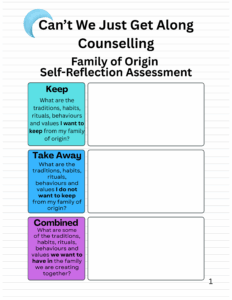
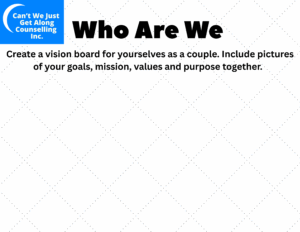
This exercise is ideal for couples preparing for marriage or cohabitation. Based on the concept of a Shared Meaning System, this exercise will help you answer the question of who “WE” are.
What is the Gottman Shared Meaning System?
The Gottman Shared Meaning System is a concept created by Drs. John and Julie Gottman are well-known psychologists and researchers specializing in relationships and marriage. Their research explores what makes relationships thrive and how couples can develop a strong, enduring connection. The Shared Meaning System plays a crucial role in their approach, highlighting the value of establishing a shared life vision and emotional bond between partners. As part of the couple’s shared meaning system, this system describes who we are and what we are working towards. Why are we together?
The Importance of Shared Meaning
Creating shared meaning involves more than just agreeing on practical matters; it encompasses building a life together that is rich in purpose and significance. When couples share a strong, mutual meaning, they are not only partners in daily tasks but also in the journey of life. This connection can provide a deep sense of understanding and fulfillment, helping to buffer against conflicts and misunderstandings.
What are the Elements of the Shared Meaning System?
The Shared Meaning System can be broken down into several key elements:
- Rituals of Connection: These are small but meaningful traditions and routines that couples develop over time. Rituals may include anything from a special way of saying goodnight to holiday traditions. They help strengthen the bond between partners and create a sense of continuity and comfort.
- Shared Goals: Having common goals enables couples to work together towards a future they both envision. These goals may relate to family, career, personal growth, or community involvement. Shared goals give partners a sense of direction and purpose.
- Shared Values and Symbols: Values are the guiding principles that influence decisions and behaviour. When couples share core values, they have a foundation for understanding and accepting each other’s perspectives. Symbols, such as meaningful objects or places, can also hold significance for a couple and contribute to their shared story.
- Roles and Responsibilities: Knowing each other’s roles and responsibilities within the relationship and family unit is essential. This includes discussing and negotiating who handles specific tasks and recognizing each partner’s contributions.
How Do Couples Build a Strong Shared Meaning?
Creating a shared meaning system requires ongoing communication and effort. Couples can build shared meaning by:
- Engaging in open conversations: Regularly discuss hopes, dreams, and aspirations. Share thoughts about what each partner values and how they envision the future.
- Creating and honouring rituals: Identify and establish rituals that are meaningful to both partners. Try to honors these rituals consistently.
- Setting joint goals: Collaborate to establish mutually achievable short-term and long-term objectives. Ensure both partners feel involved in the planning and execution.
- Respecting individuality: While building shared meaning, it’s essential to respect each other’s individuality and personal goals. Balance the partnership with personal growth and identity.
By prioritizing the development of a shared meaning system, couples can deepen their emotional connection and create a resilient partnership that can withstand challenges and changes over time.
Deciding when to get married or live together is a significant choice that depends on several factors:
- Personal Readiness: Assess your motivation and emotional preparedness. Know if you’re pursuing marriage for health reasons and feel emotionally stable.
- Relationship Evaluation: Ensure compatibility in values and goals, and prioritize open, honest communication.
- Financial Considerations: Confirm financial stability and discuss your approach to shared finances and future goals.
- External Factors: Weigh family approval and societal expectations but make choices based on your readiness and happiness.
- Career and Personal Goals: Evaluate career stability and ensure that marriage aligns with both partners’ aspirations.
- Timing: Reflect on your life stage and trust your intuition; proceed when it feels right for both of you.
Ultimately, the decision to marry or settle down is a deeply personal one, requiring honest reflection and clear communication with your partner. Reach out to one of our expert couples’ therapists to get yourself ready to share your life with the person you have chosen. In preparation, use this evaluation to look at some of the critical areas in your life that you will need to discuss with your partner as you blend your worlds. Download our family of origin assessment exercises to enhance communication. If expressing feelings is a challenge, try the couple’s communication game for more meaningful conversations.
Couples Communication Game
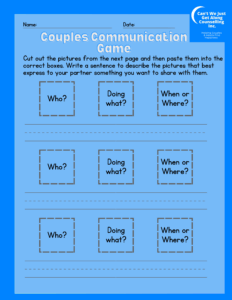
Download our couple’s communication game. Sometimes, couples struggle to express their feelings. Using this couple’s communication game is a fun way to try to express what’s important to you to your partner. Do it on a boring, rainy day or any day you feel like approaching your partner to have deeper conversations, but don’t quite know how.
Couples Wish Board
Based on the vital concept of the Reticular Activating System. (RSA ) The couple’s wish board helps them create a shared vision of the life they are building. Their wishes, wants, dreams and goals.
What is the Reticular Activating System? (RSA )
We have been creating wish boards since the beginning of time. Cave dwellers would draw the animals they wished to hunt and bring back to their tribe on the cave walls, seeking to harness sympathetic magic to ensure a successful hunt. We now understand that this practice is not magic, but instead rooted in neurobiology, as represented in the work of a brain region called the Reticular Activating System. (RSA) . This activating system, known as the RES, is a complex bundle of nerves in the brain that regulates awareness and functioning. It filters and blocks unnecessary noise and information during the message process, and is associated with arousal, tension, and habituation. Simply put, this means it will focus on the things that we put into awareness. So, if you decide, you’re going to buy a Volkswagen Bug. Your RES will start to notice all the bugs on the streets. So, couples combining their brains RAS’s can draw awareness to having a shared vision and putting it on paper can be very healthy in reaching their goals and fostering a sense of togetherness in life’s journey. So two heads are better than one.
Couples Household Chores Planner
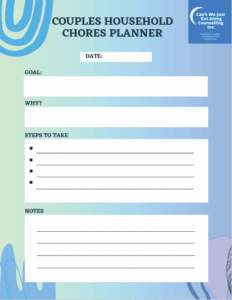
The number one content issue couples fight about the most is household chores. Chores represent power dynamics, preferences, personal differences, rooted habits and even values. It is a loaded issue for something that seems so simple. Download this guide to help you and your partner make agreements regarding this common gridlock issue. Most couples do not make explicit agreements about who will do what around the house, and covert agreements and assumptions become a breeding ground for fights and contempt. If you spend time discussing your needs and wants and setting clear goals together, you can evaluate your progress on the life you are building together. One concept to consider when talking about a potential gridlock issue, such as chores, is the idea of flooding. Read further about what flooding is and if you need help learning how to manage your anger and flooding patterns. Reach out today, and we can assist you in developing strategies to have calm conversations with your partner.
Understanding the Gottman Concept of Emotional Flooding
Dr. John Gottman, a renowned psychologist known for his research on relationships, introduced the concept of emotional flooding to explain why some relationship conflicts quickly escalate and resist resolution.
What is Emotional Flooding?
Emotional flooding occurs when an individual becomes overwhelmed with powerful emotions during a conflict. This feeling of overwhelm can occur in any relationship but is often examined within the context of romantic partnerships. When a person is emotionally overwhelmed, they may experience intense feelings such as anger, fear, or sadness, which can interfere with their ability to communicate effectively and rationally.
Signs of Emotional Flooding
Recognizing the signs of emotional flooding is essential for managing it effectively. Some common indicators include:
- Increased Heart Rate: One of the physiological symptoms of emotional flooding is an elevated heart rate, often above 100 beats per minute.
- Sweating: Individuals might start to sweat more as their body responds to the stress.
- Feeling Overwhelmed: A sense of being unable to cope with the current emotional situation.
- Tunnel Vision: Difficulty in seeing the bigger picture and focusing only on the immediate emotional response.
- Defensiveness or Stonewalling: The flooded individual may become defensive or shut down entirely, making communication difficult.
Impact on Relationships
Emotional flooding can have a significant impact on relationships. It often leads to ineffective communication and can exacerbate conflicts. When partners are overwhelmed by emotions, they are less likely to listen to each other or respond empathetically. This can result in a cycle of negative interactions, where each partner’s emotional responses trigger the other, leading to further flooding and conflict.
Managing Emotional Flooding
- Partners can adopt several strategies to manage emotional flooding:
- Taking Breaks: If a discussion becomes too intense, it may be helpful to pause and revisit it when both partners are calmer.
- Practicing Self-Soothing: Engaging in activities that help alleviate stress, such as deep breathing, meditation, or going for a walk, can be effective.
- Enhancing Emotional Awareness: Recognizing and expressing one’s emotions can help address the underlying causes of flooding.
- Building Effective Communication Skills: Learning to convey constructive feelings and listening actively can prevent misunderstandings.
Conclusion
Emotional flooding is a natural but challenging part of human relationships. Understanding this concept, as explained by Dr. John Gottman, can help individuals and couples manage conflicts more effectively. By recognizing the signs of emotional flooding and employing strategies to manage it when discussing any issues, including household chores, partners can foster healthier communication and deepen their relationship.
Melody’s Favourite Coping and Self-Regulation Techniques
1) Daniel Amen’s ANT (automatic negative thoughts) THERAPY:
I am stupid/lazy /not good enough /weak/alone. Take these three simple steps to ANT THERAPY
Become aware of your ANTS:
Challenge it: Is this absolutely true?
Replace it with a positive belief.
Example…….
I feel powerless and believe I will never overcome this problem.
Is it absolutely true that you have no power at all
What do you want to believe: I have a choice in how I cope
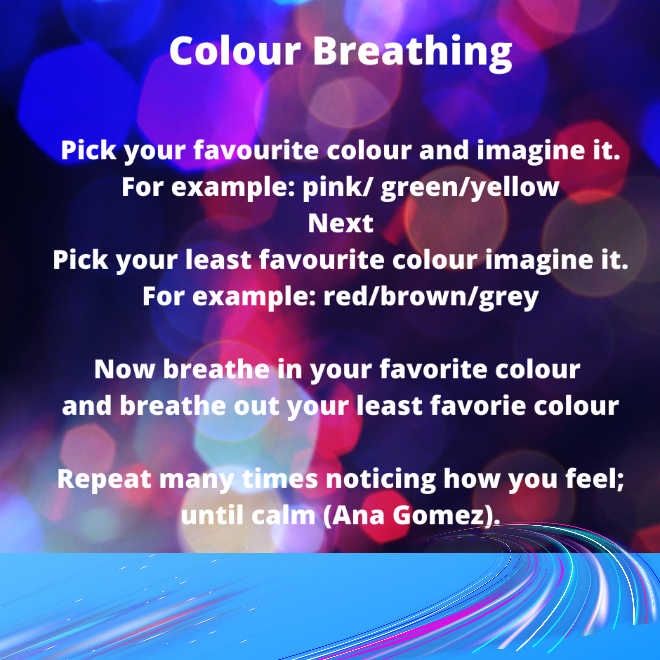
2) Colour Breathing
Pick your favourite colour and imagine it, for example, pink or green.
Pick your least favourite colour or texture, for example, black gravel or sandpaper.
Now imagine the positive colour and breathe in.
Then breathe out all the negativity in your body using your least favourite colour or texture.
Example: breathe in pink, breathe out gravel.
Repeat this exercise 4 times and notice how you feel; repeat it until you feel calm.
3 ) Grounding
Say kind statements, as if you were talking to a small child – for example, “You are a good person going through a hard time. You’ll get through this.”
Think of your favourite things. Think of your favourite colour, animal, season, food, time of day, or TV show.
Picture people you care about (e.g. your children), and look at photographs of them.
Remember the words to an inspiring song, quotation, or poem that makes you feel better (e.g. the AA Serenity Prayer).
Remember a safe place. Describe a place that you find very soothing (perhaps the beach or mountains, or a favourite room); focus on everything about that place – the sounds, colours, shapes, objects, and texture.
Say a coping statement: “I can handle this,” “This feeling will pass.” “Problems are time-limited.”
4) Come Back
When you catch yourself being caught up in worries about the future, notice that it is happening and kindly say to yourself, “Come back.” Then take a calming breath and focus on what you are doing right now. Remember, you only have today, so take one day at a time and remain curious.
5) Three Senses
Notice what you are experiencing right now through the three senses –
Sound
Sight
Touch.
Take a few slow breaths and ask yourself:
What are the three things I can hear? And what is the sound (my dishwasher hums, the dog growling, etc.)?
What are three things I can see, and what is their colour? This table (brown), the plant (green), etc.
What are the three things I can feel? The chair under me (soft), the tile (bumpy), etc.
6) Create a Self-Care Plan
List three things that you can realistically work on in the next several weeks/months that will contribute to better balance and overall wellness: Use the SMART goal formula to make sure they will be effective. How will you achieve this?
Remember to make SMART goals: S – Specific, M – Measurable, A – Attainable, R – Relevant, T- Time-bound. Also, set boundaries if you are struggling with someone; use the ‘circle around your feet’ tool for boundary setting. Draw a circle around your feet and a circle around them. Identify what is your own, in your physical, emotional, mental and spiritual space, and what is the responsibility of others. Consider what you can tolerate, accept, and what makes you feel uncomfortable or stressed, and then set boundaries with yourself and others.
7) Connecting to your own emotions
Here are a few ideas for getting in touch with yourself and your emotions
Meditate
Write in a journal
Spend time in nature.
Pray
List five things you’re grateful for
Read poetry or inspiring quotes.
Tell the story of your emotions – I’m not sure what I’m feeling, but it’s like a train hurtling down the track, and I can’t stop; I’m not sure what’s around the bend.
8) Practice Altruism
What can I do to help others?
You can be there.
You can listen.
You can do an activity with them.
You can reassure the person.
Be patient.
Remember that we are all in various stages of loss, and the grief process takes time to unfold.
“Walk beside“ them, rather than assuming you know what the person is feeling—remain curious.
Do not judge!!!!!!!!!!!!!!!!!!
9) What’s the Disaster Scenario? Face your fear and work back from there. What Dr. John Gottman calls the “disaster scenario”.
Then, create a detailed plan for all the elements you have control over and begin taking steps every day to execute the plan. I call it the “THEN WHAT” exercise. For example, I fear that I will have no money, then what… I would go to the bank, then what? They would consolidate my debts. Then, I would feel less stressed, and so on, until you reach the end of what you could do.
10) How to communicate with people when you are stressed.
Brought to us by Dr. John Gottman, this is what he calls the gentle start-up —a great way to share your feelings, thoughts, and needs. It goes like this, I FEEL __________ABOUT ______________WHAT I NEED FORMULA:
Example: I feel sad
About our fight
I also want to let you know that I am stressed and will take a break from discussing this issue for today. Can we try again tomorrow after I rest?
Melody’s Favorite Hopeful Quotes by Viktor Frankl
“When we are no longer able to change a situation, we are challenged to change ourselves.”
“Everything can be taken from a man but one thing: the last of the human freedoms—to choose one’s attitude in any given set of circumstances, to choose one’s way”
“Between stimulus and response, there is a space. In that space, it is our power to choose our response. In our response lies our growth and our freedom” –
Author: Viktor Frankl, the creator of Logotherapy
Other Recommended Resources for Couples
Gottman love notes
https://www.gottman.com/love-notes/
Marriage Minutes
https://www.gottman.com/marriage-minute/
How well do you know your partner quiz
https://www.gottman.com/how-well-do-you-know-your-partner/quiz/
Gottman Check-up
Relationship Checkup: The Gottman Institute
The Gottman Card Decks App is free and an interesting way to spark conversation.
Understand Myself and My Partner
https://www.understandmyself.com/
Turning conflict into connection
https://www.estherperel.com/courses/turning-conflict-into-connection
Bringing desire back
https://www.estherperel.com/courses/bringing-desire-back
Ten Percent Happier Podcast: with Dan Harris
Happiness is a skill you can learn. Listen to practical teachings on mindfulness and meditation to improve your life. https://www.tenpercent.com/podcast
Self-Authoring Program
https://www.selfauthoring.com/?gclid=EAIaIQobChMIibfDtoWn9AIVMQV9Ch06jQC4EA
Free Attachment Style Test | The Attachment Project
Attached: The New Science of Adult Attachment and How It Can Help You Find–and Keep–Love Paperback – Illustrated, Jan. 5, 2012
by Amir Levine (Author), Rachel Heller (Author)
Hand model of the brain- https://www.youtube.com/watch?v=f-m2YcdMdFw